
From Leonard Bishop, Author of Dare To Be a Great Writer
The first thing that gets sacrificed in the interest of good writing is the truth (2/26/98)
©Leonard Bishop
From Leonard Bishop, Author of Dare To Be a Great Writer
The first thing that gets sacrificed in the interest of good writing is the truth (2/26/98)
©Leonard Bishop
by Leonard Bishop, Author of Dare To Be A Great Writer
 This is an” advertisement for myself.” It is directed to those people who are interested in improving their writing abilities and becoming professional writers. I cannot be falsely modest or self-effacing. It is an advertisement. I am also grabbing some space and not paying for it. Ha!
All I need is 52 more pages to complete my first non-fiction book on professional fiction writing. It will have a short, realistic introduction, an index which will serve as a “table of contents” and a photograph of my blunt face on the book jacket. It will also contain a promise. “If you do not learn more about how to write a short story or novel after reading it, then give up writing because you don’t even know how to read.” When the book is finished, I will announce it, and begin taking pre-publication orders. You will probably save about five dollars. Don’t send any money now. Just a note claiming you want the book. Here’s how it all began.
In about 1970 I began teaching a private writing class in Berkeley on Monday nights. They were interesting classes and writing knowledge was coming out of me that I did not realize I contained. Socrates once said,”How do I know what I think until I hear it.” There was an elderly woman, Helen Brown, who was–and still is–a marvelous prose writer and poet. She was always taking notes. She wrote strange novels. One was about a skinny woman who was in love with a whale and wanted the enormous mammal for her lover. Helen was the traditional Berkeley “free spirit.”
One day she just disappeared. She disencumbered herself of worldly possessions and wandered. She traveled to Mendocino, a small town near the ocean. One month after I had moved to Herington she sent me a large volume, The Interpreter’s One-Volume Commentary on the Bible, with the note, “I am unburdening. I know you have always wanted this book.”
In January of 1985, I received another parcel from her. It contained 750 typewritten pages of the notes she had taken while I was teaching. The accompanying note stated:”I am still unburdening.” I was astonished. Celia said, “It was so good of her to send it,” then clasped her hands in joy. “This is a God-send. You’ve always wanted to do a book on writing techniques. You’ve just finished re-writing your novel. Instead of doing another novel, why not do your book on writing.” After some days of mulling, I accepted Celia’s advice. But I was hesitant, I was troubled.
I have no knowledge of grammar. My educational background was industrial high school, and no more. I can mortise a joint and solder an electrical connection, but if asked to analyze a sentence, I feel as foolish as if I had stumbled into a nudist colony wearing a green tuxedo. Celia sensed my discouragement, “You’re having a self-pity party, Hon,” she said.
“Look at all the years you’ve been writing. Just about every kind of writing there is. Not knowing grammar never phased you before. Write the book the way you teach. Honestly. Bluntly. You know what unpublished writers need. Give them what they can’t get in other books. Your expertise is in the craft of writing, not the theory of writing. Think of what you’ve disliked in all those “how-to-write” books you’ve read, and leave that blather out.”
I began reading Helen Brown’s notes on what I taught. They were incited and instructive, but disorganized and related only to particular manuscripts I had criticized. My instruction did not apply to everyone. I put the notes aside and used a format Celia had suggested. “Leave yourself completely out of it. Deal only with technique. People who write want specific techniques and examples. Tell them how to do it, then demonstrate how it is done through examples and actual writing.”
And now the book is almost complete. There is no lard in what I have written. Only protein. It is jammed with craft-insights that other writers have either ignored or were unable to articulate. Here’s a quick sample.
There are eight basic functions for the use of dialogue. They are: to inform, to gain information, to begin relationships, to reaffirm relationships, to express feelings, to state thoughts, to provide insight to character, to alter the meaning of a situation. But dialogue can be used for structural functions that have nothing to do with what is spoken. To change character viewpoints, to cause transitions in place and time, to relieve the “eye” from reading tedious blocks of prose, as a substitute for narration, to alter disposition, etc.
How is the structure of a historical novel, horror novel, and adventure/thriller/backsplash spy novel developed? Or the family novek, the saga novel, the generational novel, the romantic novel, the contemporary novel? What is the purpose of the sex scene? How do you write a sex scene without being pornographic, yet not pressy? Why should you use a recollection and not a flashback? Because a flashback is an abrupt interruption to the flow of the plot. It forces the reader back in time and impedes the flow ahead of the present. What is double and triple foreshadowing? When you are fulfilling the story as compared to unfolding the plot? How do you deepen a major character and how much depth do you give to secondary characters. Is there male prose, and female prose?
Whee, whee,! I am too restrained within my aged dignity to giggle and jiggle with the elation of accomplishment, but I am happy. I have written the book I wish had been written when I first began to write
I will have this book for the span of time it takes me to write 50 more pages. Then it is no longer mine. I will have my name on it, but I will feel no attachment to it. It is a finished book, but not completed. There is still so much to write about writing. I’ll write another novel, next. And learn some more. Then, perhaps, do another book on the craft-techniques of writing. Yeah, yeah. Wow. Dear God, there’s so much more to do.
© Copyright Leonard Bishop
first published Sunday, September 8, 1985 the Manhattan Mercury)
by Leonard Bishop, Author of Dare to Be A Great Writer
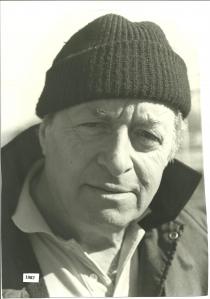
Leonard Bishop
Physical cowards are always sensitive to immediate danger.
It is now dangerous to teach writing in San Francisco and Berkeley. For the first time in my many years of teaching, the students were not afraid of me. While I instructed on the functional methods of using writing techniques, they stared at me. Cold eyes, steady eyes, inscrutable eyes watching me. The eyes were telling me, “Don’t make a mistake or you’ve had it.” I kept instructing, hoping they did not suspect my fear.
It was only when an elderly woman came into the class on Saturday afternoon that I realize why I did not intimidate them. She was wearing white cotton slacks. Her gray hair was pulled back and tied behind her neck with a white cloth. At the threshold of the room she stepped out of cotton slippers with thin soles. Two other students, a fragile teenager and a chubby male, stood up and they bowed to each other.
“Dear Lord,” I thought. “They are into martial arts and self-defense. Their hands, once used for typewriting, have become deadly weapons. If I drop a participle or misuse an adjective, they’ll flip me out the window.” Of course, of course, I should’ve known. San Francisco and Berkeley have become violent cities. The streets are moderately safe only for those who could defend themselves.
They sat before me, so serene they seem to sleep. They were in a state of metaphysical balance and mystic spirituality. Part of my discomfort came from realizing they were concentrated on listening to me. I could not declare outrageous contradictions and back them up with more outrageous contradictions. Students who actually listen to instructors are frightening.
On Sunday, a “Meet the Author\Instructor” reception was given. Celia, dressed in a fashion that was Berkeley-chic and Kansas-wholesome, was beautiful to look upon. Someone handed me a bottle of beer with an “easy-open” cap. I moaned and groaned and could not twist it. A seventy-year-old student stepped over and took it from me. He was lithe, toned in muscle, not a creak or tremble in him. Suddenly, a gut-ripping shout burst through his beard, “Haaiyaah!” And snap, the bottle was opened, cap crushed. He bowed to me, saying, “Uncenteredness is debilitating disharmony.”
The modern “pioneer spirit” is being replaced by the “new wave” of Japanese, Chinese, Korean, Vietnamese techniques of self-disciplined and self-defense. You are not only required to train in Sai, Tonfa, Nunchaku, the spear, the broadsword, and three section staff–you are also persuaded to meditate, to unite your mind with “cosmic oneness” and become mind-less. There is not good or evil, there is only Is and You, who isn’t.
The next day I wanted to be directly critical, “You students are not writing enough. Stories and novels are not written by writers who are distracted from their commitment. You had better be you and not someone who is not.” I kept silent. For all my interesting compulsions, not one of them is a”death-wish.” These people were into Tae Kwon Do, Tai Chi Chuan, Tai Chi Chi Kung, Akido with Ki, Tai Chi Chuan/Chen Style from mainland China, and two students were studying the African-Brazilian Capoeira. Even now, I’m afraid to state the names of the students. I might misspell them and they’ll beep-beep out cosmic messages to Manhattan where these schools of tranquil mayhem are beginning to open.
Where is the era of “the writer?” Did Scott Fitzgerald stand before his desk, doing breath, balance, back, and stretching exercises before writing? No. He wrote the American way. He gulped his ration of booze and staggered to work. Eudora Welty never indulged herself learning intercepting\strikes, hand switching, footwork mobility, before developing her velour prose to create fluid characterizations.
Finally, before the classes were over, I did do something courageous. A young student, wispy of build but with callous on the edge of his hands, stood up and bowed to me. “Mr. Bishop,” he said, as calm as a morning pond. “Your aggression against literary agents and publishers reveals a dissonant note in the harmony of your offering.” That did it. My restraints, sponsored by a deep cowardice, were torn. I stood up and paced about the room, my voice loud and blunt.
“The streets aren’t safe for you people, right? You want to protect yourselves so you can keep writing, right? Okay. Don’t just protect your bodies and let your mind get ripped-off with cultic ceremonies and rites. There are plenty of rape prevention and self-defense centers that you could turn you into warriors without infecting you with exotic persuasions. They’ll teach you street-smarts and how to handle armed assailants. You’ll learn how to turn common items into weapons when you need them. Car keys, combs, belts, rolled newspapers, toothpicks and clothes pins if you carry them. I’ll back any committed writer’s concentration against some WuShu master who is on the high plateau of meditation. Don’t blow five years becoming some Jeet Kune Do black belters, and do instead write three fine novels.”
I waited for them to charge at me. I saw myself battered and oozy mush and clumps of gray hair. They were silent. I look for Celia, but she had left earlier. The drone of my raspy voice had driven her shopping. They did not look at me. I returned to my chair and picked up a manuscript. “All right–I said my piece–let’s get back to work.” Someone sighed, another student coughed. Their synthetic composure had lessened and their interest in writing slowly increased.
I was not wrong, I was not right. I was only centered in my own form of spiritual unity and universal utility. Do everything you can to keep your life safe, but don’t let the methods of survival become your way of life. None of these martial arts disciplines teach individual-for-individual, day\after\day love. I am biased, I suppose, and narrow of vision–probably stolid and just uninterestingly earthy. But coming to a state of Not Becoming can’t be as warm and loving as being because you are.
©Copyright Leonard Bishop
(first published Sunday, July 28, 1985 the Manhattan Mercury)
by Leonard Bishop, Author of Dare To Be A Great Writer
Leonard Bishop
Before addressing myself to letters I have received about questions on writing, I will first state my attitude. I read each letter carefully and regard each letter seriously. I’m not argumentative or tyrannical, assertive, cynical, or belittling. Out there, wherever the Manhattan Mercury is distributed, there are people who are interested in writing or want to become writers. I am not some how-to-write book-thumper evangelizing that writing is the way to salvation. I have some information writers can use. I am happy to part with it. I am not arrogant, but I am not exceptionally tactful. I am a professional writer and I care for people who want to write.
The first letter is from someone who states he doesn’t remember my name, where I live, nor the name of the column. He has misspelled the name of the newspaper and signs his name as though an ill chicken was squatting on the paper:
From: a nebulous inquiry: “Who is the author of the work of, recurring phrase, if not the title… “The heathen Chinee”…?
Answer: I know the author and work, but I do not intend telling you. I am a writer, not a library researcher. Any fact that I can find for you, you can find for yourself. If you are unable to get around because of physical disability, I’ll direct you to some agency that will provide you with assistance. They will even bring you the books you need. If you have no, “literate” friends to appeal to, there are many correspondence clubs to contact. They are eager to fulfill the needs of lonely, isolated, or socially timid people. Thank you for your inquiry.
There are two parts to the next letter which I will answer in two parts. This reader is in vigorous disagreement with the statement I wrote about the joy and happiness there is in being a writer. He claims to know that writing is “hard work” and says “I hate hard work. Hard work is hard. It’s painful. It causes suffering.”
Answer: Report the one who is standing over you with the shotgun and forcing you to write. That should relieve you of the suffering you are experiencing when writing. Then you no longer have to aspire to be more than what you are now. You can use the remainder of your time sagged before the TV set, glutting on food, letting your spine turn to warm noodles and your mind into melting Vaseline.
Work is hard only when you are working at what you dislike, what shames you, what leaves you ungratified. There are two essential requirements that writers must begin with before they begin “making their mark” as writers. Character and interest. They must have both, at the same time. One without the other is like having a hand without a wrist. Go into dentistry: it’s always more fun pulling out someone else’s tooth.
This letter writer also claims “I write about tragic confusion… About the catastrophes of ordinary life. I write about impoverished minds.” He also states that he has even spent seven years–“because I hate hard work”–completing a 600 page novel and “If the book is never published at all, I will still know in my heart of hearts that I have created a work of art…”
Answer: The primary intention of the writer is to tell a story, reveal depths of human character, to entertain, to create an interesting fictional reality. Reading about tragic confusion or catastrophes of ordinary life and impoverished minds is about as interesting as watching a beetle urinate on a gladiola. It is abstract, vague, and tasteless as numbed teeth.
People want to read about magnificent catastrophes cities leveled by hurricanes and bombs, and about the people caught in the disasters. They want horror and terror stories in which people are helpless against the supernatural, the homicidally insane. They want to read about love, about heroes and heroines. They want romantic sagas, enchanting fantasy novels, dazzling ministries, astonishing galactic events. They are not interested in mite-minded writers who wallow in whining and banality. They don’t want to read about the troubles they already have in exactly the way they have them. They want entertainment, not reminders of their perpetual misery.
As for the “work of art” you have created–you are diddling with yourself. Most publishers are dense, without business acumen, and devoid of “literary taste”. But even they can recognize a “work of art.” There has not been a work of “writing art” published in the last 20 years. I doubt if you are the one who will break that deplorable record.
This letter is from a woman who wants to write children’s books and is stalled in her efforts because there are no people she can talk to about writing. “Would you perhaps know of any group of reasonable, sane and well behaved people in the area who meet in order to read or talk over their writing?”
Answer: I know your problem (having lived in Kansas for over a year) and it is serious. But I do not know of any writing groups in the area. I’m sure there must be some. Why they keep hidden is beyond me. People need each other. Writers need other writers. It keeps them from feeling exiled and alone. In their struggle to learn, they heal hurts and help each other learn. The only way I can help you is to publish your entreaty and hope that some people who belong to a writing group will respond. I will keep your letter and forward any replies that are sent to me.
I appeal to any writing groups in the area to contact me so I can apprise her of your existence. Remember, you were once in the same desperate spot she is in now. Writers should care for each other.
©Copyright Leonard Bishop
(first published June 30, 1985 the Manhattan Mercury)
by Leonard Bishop
Leonard Bishop
When speaking before groups who are interested in writing–or a classroom of students–there are two questions I am always asked. Here are the questions, and my answers.
“Is the hallmark of a genuine writing talent only when writers get so deep into their novels that the characters start writing them?”
That is a myth. Characters are dead images. Only the writer can give them life. If the writer doesn’t put them onto paper they cannot exist. Characters speak, act, think and feel, only when they are written to do so. Writers must always be in control of their writing.
Characters have no minds, no relationships, and do not traipse about the pages in self-motivated search of the story. They cannot analyze, interpret, reveal or create themselves.
Writers are not some bogus mediums sitting in dumb trances biding time until the spirit character wakes them, demanding,”Hey, wake up, I’m here.” If characters were floating around in some incorporeal state, until they locate a wishy-washy writer to express them, they would want to dominate the novel. They would obsess on being the stars, and overwrite.
This long-standing myth that “characters write the writer” is a cheap bid to romanticize the act of writing. It is a mistake promoted by writing instructors who have graduated from creative writing classes but have hardly written, and rarely published. They are unworldly academics shrewdly sustaining their employment. They are breeding other creative writing instructors who will also victimize naive students with this asinine myth. From the beginning to the end–the Alpha and Omega–the writer does it all.
“Is my writing without merit because I enjoy writing? I keep trying to suffer for the sake of art, but it doesn’t happen. I just love writing. It makes me happy. Am I kidding myself?
Keep writing with that attitude and you’ll accomplish splendid works. Whatever suffering the writers are supposed to experience is the living they have undergone before they begin writing. Anyone who deliberately causes an abscessed tooth is an idiot. It is impossible for any human being to remain within a profession for perhaps 30 years in a continual state of suffering.
People should not misunderstand the hurting they go through as they live, with the feelings they experience when they write. Everyone suffers. It is our worldly inheritance. But there are basic reasons for why people want to become writers. None of the reasons have to do with an ecstasy for suffering.
Some writers find the world too much for them and they turn to writing for the joy of self-expression, the discovery of an identity. Others find the world is not enough for them. They want to fatten it with themselves. Enrich it with the marvel and wonder of their knowledge, their perceptions, their understanding of “what is truth.” Other writers find the world disgusting and corrupt. They want to perform surgery on its guts, its purposes. I could go on for pages listing the reasons why people become writers. Not one of them would contain a desire to suffer.
I have been involved in many jobs, occupations, professions. Not one of them ever established in me the happiness I feel while writing. Not only because writing is what I do best–but because it is the last stage in my search for “self.” I am constantly involved with my life and do not feel vanity, conceit, or an overbearing elitism.
My mind interests me, my feelings fascinate me, my concepts are constantly provocative and changing. What I take from people and give to people is always enchanting. There is no event, sensation, response, or relationship that is ordinary to me. I am a unique melange of differences and varieties. I am an adventure, an operetta of boisterous melodrama, an exiled strand of music waiting to be symphonized, a lark gushing freely to the heavens. I am a lonely child studying a leaf, an aged man held in a loving memory, a mother giving birth, a whore flaunting her contours, a priest weeping in the confessional. I am a time of grief, an exotic aroma spilling from the jungle plant. I am a nasty cab driver, an ulcerated headwaiter, and I can even be a rainbow.
I know who I am and I am learning more about myself every day I write. My suffering happens when I am not writing.
© Leonard Bishop
(first published Sunday, April 21, 1985 the Manhattan Mercury)
A Beautiful Reminder of Christmas! Thank you, Leonard!
by Leonard Bishop

Leonard Bishop
My son, Luke, asked me, “Dad, is there a Santa Claus?” I sat fixed in a painful decision. Five-year-old children must have a sense of fantasy and fable. But when a well-intended lie sneaks into love, the lie remains and the love is changed. The heart carries a soiled shadow. Children must soon learn the truth and the truth is not always cruel.
I told him, “I’m sorry, Luke. There is no Santa Claus. He’s just a chubby fella someone made up a long, long time ago. When you get presents on Christmas, your family and friends give them to you. Because they know you’re special, and they love you.”
His gentle blue eyes clouded with sorrow and I held him and stroked him and hushed my voice near his face. “Would you like me to tell you about all the marvelous gifts you already have? Gifts you’ll be getting? Gifts which that ‘let’s pretend’ fella, Santa Claus, could never bring you?” He pouted sadly, and nodded.
“Your mother is a miraculous gift,” I told him.”She brings you into life as a gift to the world. She feels you from her deepest self. She tends you with kisses and secret whispers and giggly games and she is the first one you love. She never goes away to a far, far place while you wait for so long you begin forgetting her. She is always there, holding you, guarding you, giving to you. She is a celebration of love and never tires of being with you. And one day, very suddenly, you are all grown up and anxious to leave and she watches you go, but you are still softly hugged in her heart.
“Candy canes crumble and popcorn dries and yummies are quickly swallowed and gone. But the sun always rises to spread its glory over the land like warm caramel. Christmas trees wilt and tassels tear, but the moon forever slides into the dark sky to dangle like a glowing bulb wreathed in a cloak of glittering stars. The decorated stockings frazzle and bright gift wrappings are thrown away but the gift of the earth is always before you, with forests and hills and oceans and lanes leading you to curious places you have never been before. Greeting cards are lost and visitors drift away, but the festival of seasons keep changing in the world, year after year. They bring their different smells and feels and tastes and startling colors–and remember that morning you saw your first rainbow? It was such a lovely ribbon wrapped around the world.
“There is the gift of playing and being studious and the times of learning given by your school teachers who care for your heart and mind. They teach you true stories and numbers and the endowment of astonishment and wonder. They read books to you until you can read. You learn about men and women who opened the darkness of the world, and shaped the nations of freedom and light. Instead of plastic and tin cheapies that soon break or are stepped on, your teachers present you with the human adventure and guide you in your rush to the dreams that never wear out.
“When you awaken you think about the wonderful gift of friends, and they think about you: ‘Hey, let’s wrestle, let’s hide in the yard, wanna go fishing? Look at what I colored–good, huh? Oooooh, you flopped in the mud and your mom will get mad; did you see that lightning last night? Wow, I was scared. Let’s strip to our skivvies in’a rain.’
“Friends are funful, playing and brave and sometimes they cry but you never wait a long lonely year for them to come over and mess your room and tell you jokes your folks are not supposed to hear. The fire engines and fierce robots get broken, but your friends are right there when you need them and their laughing is not some ho-ho-ho make-believe.
“And tomorrow, Luke, isn’t that another wondrous gift that life gives you every day? Don’t bother to count all your tomorrows, Luke–will you run out of numbers. Tomorrow is a greater expectation, a better hope, a longer time of laughing. A strong ambition, a fuller reaching out to grasp more of life. One day tomorrow you’ll play baseball and study the eye of a frog; you’ll read history and tinker with machines and put on serious clothes for a school dance. You’ll drive a car and begin a joyous search to find your own precious love. Sometimes todays are dark–especially when Daddy says there is no Santa Claus–and there are some hurts and a little fear–but joy always comes in the morning of tomorrow which is polished and glossy and waiting for you to hurry into it.
“The finest gift your mother and father give you is your awareness of God. You can’t see God and you can’t always understand God; for God is not pretend. If you could reach your hand into your heart, then you would know where God lives. And if I take away your Santa Claus and bring you the joy of God, then I am your friend. And here’s a marvelous truth, Luke–the One who created the entire world and all the heavens, knows your personal name and dearly loves you. Wow, Luke, that is such a magnificent gift.
“You can give presents at Christmas because you love someone–and you can receive presents at Christmas because you are loved. All happiness comes from loving and being loved. And if I say there is no Santa Claus it’s only because we don’t need him to know the truth of love–we only need each other.”
My son Luke sat in silence, and I waited. He slowly put his arms around my neck and whispered, “Dad, I love you,” and I thought whatever I give my son, God first gave to me, and Christmas is just another day of loving.
©Copyright Leonard Bishop
(first published Sunday, December 2, 1984 the Manhattan Mercury)
by Leonard Bishop
About 20 years ago, Boston University approached me with an offer to establish a “Leonard Bishop collection.” It would be placed among the other writers, artists, stage and screen performers they considered distinguished enough to be exhibited. I was flattered, but reluctant.
I did not want my grubbily handwritten manuscripts–the writing, rewriting, and re–re-re-re-re–writing of scenes put on display. I would seem stupid to the public. They would see my Mongoloid script and comment, “If he’s such a hot-shot writer, why couldn’t he get it right the first time? Goodness, look at his spelling! Is that English, or Trans-Carpathian?”
But Boston University knew how to appeal to me. They indicated that whatever writings, notes, lectures, reviews, essays, stories, I sent them, would be appraised for value and I would be allowed to use it as a tax write-off. I immediately accepted.
I have just completed another novel. All the pages, notes, re-writes are in a grocery box. I am now cleaning my desk of material I collected on it in this year and a half of writing the novel. Whenever I do this chore, I always envision what will not be carved on my tombstone. “His profession was writing\His talent was in being orderly.” But it must be done. I must find every scrap of paper–three lines might be valued at 40 cents; an unused verb, 7 cents; a succulent metaphor could bring as high as 17 cents. While I am not a miser, neither am I a spendthrift. Here is some of what was on my desk:
- The central character in the novel–a young writer working for scandal magazine–must interview a former policewoman who has information about the murder of the nun. The policewoman is hostile. He leaves feeling the nun is more mysterious than before. (Note to Myself: the scene may not have enough relevant facts to justify 16 pages. Make more interesting or substitute another scene.)
- The young writer is attacked by two men who warn him off his investigation. He staggers to mother’s house to be treated. She is not home. He knows she is out drinking and probably with some man. He sits on the steps waiting and remembering his past. (Note to Myself: the flashbacks are too long. They impede the on-going pace of present story. The material is static. While it motivates the character it does not deepen him. The scene is good, but ineffective. Eliminate flashbacks and filter material through a narration and quickly written recollections.)
I have always advised that writers should keep hidden. Don’t go public. Whoever reads what you write may admire your talents–but when they meet you in person they might burn your books. If the literary committee at Boston University ever learned what other writers keep on their desks while writing, they might disband the “Collections” department and relegate it to “Janitorial Services.”
© Leonard Bishop
(First published Sunday, March 31, 1985 the Manhattan Mercury )
by Leonard Bishop
Leonard Bishop
When I was 50 years old I began feeling happy, and this immediately upset me. I could handle sorrow, depression, morbidity, anger–but happiness was a shock of confusion. It wasn’t “me.”
If I wasn’t brooding, I didn’t feel alive. If I did not feel shame for what I was like, it was a wasted day. Regret for past failures helped me feel adjusted to my society. Deep and tormenting guilt gave me the spiritual agony I needed to feel comfortable. Resentment, envy, bitterness, were inbred traits in my identity. They kept me feeling in common with the world. I lived in dark concealment and people thought I was a “nice guy.” This life-long deception made me feel superior.
But there I was, at the age of 50, happy–and utterly confused. How could such an unexpected and horrible condition happen to me?
Then I understood. I was busy writing a novel. For two entire weeks it had absorbed me. I was reaching depths of character I had never touched before. I was creating dramatic effects I did not believe possible. I was so concentrated on what I was doing, I had forgotten about myself.
Yet the world had not exploded. Children still laughed; birds still perched on branches and gobbled worms. Life was continuing without my worry, my agitation. Nor had I been destroyed by my two-week absence from myself. I was astonished by this realization.
By getting away from myself, I was relieved of a grinding, agonizing pressure of constant self-condemnation. For a little while I had anesthetized my enemy. Me. My past that was badgering me today.
Well, if happiness could happen by accident, or by an odd shift in circumstance, then I could make it happen, deliberately. To hell with my long history of miserable yesterdays. To hell with the ugliness of my past. Yes, to hell with all that dead, stone-heavy junk.
Whining about having been born in poverty; carping about parents who did not enjoy my birth or truly love me; hating the world for having been born Jewish in an era when it was as ugly as being born black today. Justifying the rottenness I did by listing all the rottenness that had been done against me. Scheming for admiration from people who, if I knew them, I would not like. To hell with that past. The memories were so worn from use, they were no longer clear, or accurate. They were not unique.
To hell with being ashamed of my low educational background–getting dumped into industrial classes set up for dummies. I had been a thief, and violent. A drifter, a mooch, an amoral opportunist who loved to lie and avoided the truth. What did it matter now if people had once used to me, abused me, gutted me for any worth I might have had, and flushed the shell of me down. Living inside those remembrances and dragging them into my today, was stupid. To hell with them–and that’s where they belong–in hell.
I’m 50 years old and I learned that I could be happy by getting away from myself, away from rolling through life in a wheelchair of memories. I have no cause for shame today.
I have a marvelous wife and splendid children: I am loved. I am a writer of stories, biographies, manuals, television scripts, novels. I am teaching at an esteemed university–men and women with educations pay to hear me. I have no cause to be afraid that if I let people know what I’m really like, they will despise me. Why don’t I pry off the sewer lid I’ve kept on my life and let out the stink of decay and death? I’m tired of myself. I’m bored with myself. I’ve been swelling in sour juices of self-pity for so long, my soul is marinated.
I don’t have to start over at 50. I just have to keep getting away from myself, my past, and lived in today just the way I want to become. Other people have done it, and I am like other people. And when I do it, other people will also do it because they are me.
I don’t have to assert my authority at home by jamming my wife into a corner and stomping her down like unwelcome dirt. I don’t have to be a startling speaker by using obscenities that would petrify a degenerate witch. I don’t have to lie about adventures I have never had, to make people believe I am remarkable. Instead of being viciously aggressive to be esteemed as interesting, begin searching for the interesting depths in other people. Look at what is right today and to hell with what went wrong yesterday. Don’t dig among the dead, die with the living.
Hey, Bishop, go easy. You can’t suddenly dump 50 years of what you contrived to become, to reveal what you really are. Wrong, Bishop, dead wrong. Show me the universal law, the immutable law that says you can’t. All it takes is hope for a better life, the need to give love, faith in yourself and trust in God–which you already have–or you wouldn’t be here today.
The guilts, the shames, the regrets you once lived, are dead. You revive them by resurrecting them to rule your today. If you cannot bring back all of yesterday, then why bring back only the pain? It is dead.
Every time you feel deprived, think of what you have. Every time you doubt, realize where you are certain. When you hate someone think of how it feels to be hated. For every phony characteristic you drop, allow a natural one to emerge. Look at people’s eyes, their faces, their bodies. Hear their words, listen to their ideas. People want to love because they are lonely, just as you were. Open your life to everyone. They cannot hurt you any more. Hope is a shield, happiness is power. Love is joy.
I am good. The more of me is greater than the less of me which might be evil. I am worth being loved because I can, sure as people have hearts, give love. To hell with yesterday. I’m going to risk all of what I am, on today–and get away from myself.
©Copyright Leonard Bishop
(First published Sunday, March 24, 1985 the Manhattan Mercury)
by Leonard Bishop
Leonard Bishop
I attended a production of The Taming of the Shrew at the South High Little Theater in Salina. I left feeling that Shakespeare was finally discovered and portrayed sensibly. It was a noisy, animated, energetic cast. The players were able to overcome the prolonged speeches by translating them into action. The colorful costumes against the stark black setting enhanced the stage. At times their enthusiasm became fearful. Petruchio played by a strapping youth (Cory Temple) insults Kate (Heather Nye). She whams on the cheek, knocking him from the bench. For the next four minutes he seemed to speak through loosened teeth.
Whatever outside action happens occurs off-stage. It was a wise arrangement because in 1613, during the opening of Henry VIII, the global theater was demolished by fire when cannons were fired to herald the King’s entrance. Happily, the school remained intact.
Like most of Shakespeare’s plays, the story is simplistic. Lovely Bianca, the genteel daughter of a reputable family, wants to be married. Tradition forbids her to marry until her older sister, Kate, is married. No male would dare trifle with Kate. She is a shrew. Acid-tongued, fiercely righteous, and bullying, she frightens any swain who would pursue her. Until Petruchio, a vigorous stud from Verona, decides to take on this formidable woman–for a considerable dowry of money and property. The bulk of the play deals with his cunning, unprincipled manner of “taming the shrew” into submissiveness, and silence. The sub-plot considers Bianca and how she is wooed by two ardent suitors.
Originality was never an obsession with Shakespeare. Taming of the Shrew was a play adopted or rewritten from The Supposes, Gascoigne, who adapted The Supposes from Aristotle’s play, I Supposity.
Were Shakespeare alive today he would be incorporated into a “world industry,” with a multitude of tax write-offs. He was a production-line of writing that only his demise could stop. Before the ink was dried on the parchment, the play was on the boards. Most of his output was offered during the reign of Queen Elizabeth who was a miserly woman. She would not confer knighthood upon him because it was too costly. Yet his prolific yield of writings probably established the first theatrical employment agency.
In the South High production, the director, Linda Webb, revealed an exceptional understanding of how to present a Shakespearean play. Find a version of The Taming of the Shrew that eliminates the wordy musings and asides–the elongated, elliptical, endlessly evolving speeches–and get to the action. Don’t handicap the students with tongue crippling tirades whose meanings are so profound they are lost while trying to be understood. Let the kids have a good time and allow their pleasure to stimulate the audience. Keep the people awake.
Shakespeare did not desire the type of immortality he has been given:” the greatest playwright of all time.” His intention was to be used as a reference source throughout the ages. He knew that mundane thinkers like Sigmund Freud would quickly deplete himself of insights into human motivation. Gross and humorless Nietzsche would need humane perceptions. Marcel Proust, who rarely left his boudoir, and had a well-thumbed him and monks habit copy of Shakespeare’s works at his bedside. Balzac, who wrote in monk’s habit, rewrote Shakespeare’s sonnets into short stories. George B. Shaw not only imitated Shakespeare’s structure, he actually pilfered from his plays. Shakespeare aspired to aid ” speech classes” by composing orations for actors trying to overcome enunciation impediments. His peeve against young people is expressed in his knowing that generations of high school students would be forced to read his plays.
Before Shakespeare became a playwright, he was an actor. Therefore he wrote his plays to showcase the actor. Hamlet, Lear, Othello, Romeo, Julius Caesar, Macbeth. He paced his speeches is carefully. He knew that while the actors were reciting, some of the audience would be busy socializing. Foppish royalty or young gallants would listen for a bit, then disagree with the text–and shout their disagreement. Often the performers would lean over the stage and conduct an unruly debate. Barmaids hustled about the audience, serving food and drinks. It was not uncommon for an actor to be pelted with a leg of mutton or be forced to interrupt a recitation to toast an aristocrat.
People attended the theater as an occasion for meeting friends, having a good-natured brawl or dual, spreading court rumor, catching up on the latest fashions and intrigue. Seeing a play was a secondary interest. Actors were without consequence or stature. They were token celebrities, allowed attendance at royal affairs to demonstrate the liberality of the host. Mere costumed and rouged monkeys on a string. But Shakespeare was ambitious and a climber. Many of his sonnets were written to the handsome and influential Lord of Southampton.
It was a wild and whimsical Elizabethan times and A Lover’s Complaint was The Rape of Lucretia and on The Twelfth Night it was As You Like It. No such madcap shenanigans occurred at the South High little theater. The audience was attentive and engrossed in the excellence of the performances. If I am at all critical, it would be because the players were not advised to remain onstage while the ovation of praise continued.
© Leonard Bishop
(First published Sunday, March 3, 1985 the Manhattan Mercury )
by Leonard Bishop, Author of Dare To Be A Great Writer
All writing is either a protest or a confession. What I write in this space, is both. My wife and I can no longer speak freely or forthrightly to each other. The belief that I have always upheld –” if you have talent, use it!” –has backfired against me. This winter Celia decided to redeem her elapsed teaching credential and is attending Marymount College in Salina. She has been assigned to write class papers. What we would never dare admit or speak about has been forced to surface. Her intelligent is more interesting, the dynamics of her personality more forcible, and the brilliance of her writing talent turns mine to a faint simmer.
This crushing disaster happened last week. I had finished writing a scene from my novel. I rush into the house, anxious for my fix of approval and flattery.” Babe, read this scene, will you? Tell me what you think of it.” She glanced at me with aloof disdain. I’m writing a class paper on Plato’s symposium. I’ll read your scene next Tuesday.” I recovered quickly from the rejection. And just to be gracious and reaffirm my stature as a writer, I said,” I’ll read your class paper. I might be able to show you some professional structures. You know, some ultra sophisticated techniques.” She chuckled with nasty superiority,” Really?” She handed me the paper and shrugged. As I read my jaws clench, my legs shuddered, I began sweating. The prose was lyrically majestic, the critical insights astute, her concepts, panoramic. Although I have never read the symposium she had turned it into an enchanting adventure.
I smiled weakly,” Erh, heh,uhhm – this is not bad, Babe.” She snatched it from my trembling fingers. I said,” Hey let me read it again. Just to check the spelling.” She clutched it to her bosom.” No. You’re running dry, and you are unprincipled. No one’s writing is safe around you.” Oh, how peeved I become when someone understands me.
The next day she drove to Salina. I rushed into her room and, like a master spy, began reading the papers she had written. I was cold with awe and inflamed with envy. She was consistently splendid. The inspired phrases poured dripping from her ballpoint pen. Like:” penetrating superficialities.” Marvelous. I could use it when I wrote about television surveys that explored human relationships. In her analysis of Voltaire’s Candide, she wrote” illustrious buffoonery” and” cacophonous claptrap.” Just yummy! I must have these phrases when I write about the function of political campaigns.
Oh, that mean, mean woman, I thought. She deliberately waited for this critical time in my life to unleash her talents. And to think that once I encouraged her.” You should try writing, Babe. You might have some talent. It’s an amusing escape from the daily tedium.” Yet I have no true cause for whining. We always knew she was more scholarly than I am. Her vocabulary is larger, her analytical capabilities keener. Her intuitive responses to people and events, more perceptive. These virtues were a gratifying contribution to our marriage — as long as she kept them hidden.
When we married, we had an unspoken arrangement. Since my ego was so fragile, all attention and celebrity would be focused on me. Her reward for the sacrifice and stroking would be constant love and uncompromising fidelity. I would provide economic support, and the unrestricted privilege of keeping our accounts and now, I am betrayed.
Aware of some minor sleaze in my character, Celia double locks her room and always carries the keys on her person. She hardly talks to me in fear that I will steal her ideas, her phrases, her imagery. I can no longer show her what I write because in fact, she might improve it. For days I have thought about a solution to this unexpected disaster, and this was my decision: since I am a genteel man and too considerate to compete with her talents– I will resort to the only masculine alternative I have–I must stop her!
I now wear my socks for only half an hour, then toss them into the laundry bin. I do the same with undershirts and shorts, then pout,” Hey, babe, how about doing some wash?” Every time I see her in her room, writing, I find a way to interrupt her.” Babe, would you wind my wristwatch. My fingers are too thick,” or” Would you tighten the screws on my eyeglasses–they are too small for me to see,” or” Remember that tape cassette of me addressing a writers conference five years ago? Let’s search the whole house and try to find it.” Her willingness and patience is driving me crazy. And she’s still writing.
She reads Chaucer, St. Thomas Aquinas, Boethius, Etienne Bonnot De Condillac, Pavel Borrissovich Axelrod, Nicolai Gavrilovich Chernyshevsky, Jean Baptiste LeRond D’Alembert–and really understands them. I always knew that universities were breeding grounds for radicals and social climbers. Oh, how I hope that some truly enlightened women would write to her and persuaded her to return to the traditional and delightful ways of female subjugation and anonymity.
I did not sleep last night. I lay awake in a convulsion of anxiety. Celia had put down the book of medieval philosophy she was reading and said,” Tomorrow, I think I’ll begin writing a novel.” I lay beside her in rigid fear. Then she rolled onto her side and said something that made me want to fall to the floor, grovel before her and beg,” Please, babe, don’t do that to me. Don’t ruin me!” She had said,” I heard that the largest newspaper in Wichita is looking for someone to write a column titled” Quadruple Viewpoint.”
©Leonard Bishop
(First published Sunday, February 17, 1985 the Manhattan Mercury)
 Leonard Bishop